https://doi.org/10.36253/rse-19532
Received: December 23, 2025; Accepted: February 23, 2026; Published: June 15, 2026
Classifying Difference – Italian Immigrant Pupils in US City School Systems, 1880s to 1920s1
Classificare la differenza – Studenti italiani immigrati nei sistemi scolastici urbani statunitensi (1880- 1920)
Humboldt University of Berlin, Germany
fanny-lynne.isensee@hu-berlin.de
Abstract. At the turn of the twentieth century, New York City’s public schools were confronted with unprecedented challenges. The consolidation of Greater New York in 1898, combined with massive immigration – particularly the third wave (ca. 1880-1920) bringing South and Eastern European immigrants – transformed the educational landscape. By the late 1920s, over two million of the city’s 5.5 million inhabitants were “foreign-born”. Children from Southern and Eastern European immigrant families faced particular stigmatization, with debates focusing on language barriers, national stereotypes, and varying educational levels. This contribution examines how the Board of Education and School Superintendents conceptualized and managed immigrant children who deviated from institutional norms. Drawing on archival materials including reclassification reports, psychological assessments, and surveys from educational research units, the study traces how educators operationalized psychological and psychometric knowledge from contemporary experts in statistics, developmental psychology, and intelligence testing. Additional sources – administrative reports, medical evaluations, and psychological assessments – illuminate the bureaucratic mechanisms underlying different classification models. Comparing New York City with Chicago as a second immigration hub reveals how municipal education systems identified certain immigrant groups as “problematic”, labeling them as «backward» or «retarded». This analysis shows that testing and reclassification were not merely administrative procedures but technologies of scientific management that constructed cultural ascriptions and hierarchies. Through precise documentation and measurement, school administrations created systems that were ostensibly designed to integrate immigrant children but ultimately reinforced social stratifications. The article thus exemplifies specific critical intersections between education, immigration, and pupil normalization through particular practices of school administration and organization.
Keywords: school administration, urban education, immigration, New York City, Chicago.
Riassunto. Con l’avvento del Ventesimo secolo, le scuole pubbliche di New York si trovarono ad affrontare sfide senza precedenti. La nascita dell conurbazione “Greater New York” nel 1898, unito all’immigrazione di massa – in particolare con la terza ondata (circa 1880-1920) che portò immigrati dall’Europa meridionale e orientale – trasformò il panorama educativo. Alla fine degli anni ‘20 del Novecento, oltre due sui 5,5 milioni di abitanti della città erano “di nascita straniera”. I bambini delle famiglie di immigrati dall’Europa meridionale e orientale vennero particolarmente discriminati, mentre il dibattito era imperniato sulle barriere linguistiche, sugli stereotipi nazionali e su livelli di istruzione disomogenei. Questo articolo analizza in che modo il Board of Education e i sovrintendenti delle scuole rappresentavano e gestivano i bambini immigrati che deviavano dalle regole delle istituzioni. Sulla base di materiali d’archivio, tra cui report di riclassificazione, valutazioni psicologiche e sondaggi eseguiti da unità di ricerca educativa, lo studio cerca di ricostruire il modo in cui gli insegnanti hanno reso operative le conoscenze psicologiche e psicometriche tratta dagli esperti in statistica, psicologia dello sviluppo e test di intelligenza loro contemporanei. Ulteriori fonti – report amministrativi, valutazioni mediche e valutazioni psicologiche – consentono di comprendere i meccanismi burocratici alla base dei diversi modelli di classificazione. Confrontare New York City con Chicago, intesa come secondo polo di immigrazione, rivela come i sistemi educativi cittadini abbiano identificato alcuni gruppi di immigrati come “problematici”, etichettandoli come “indietro” o “ritardati”. Questa analisi mostra che i test e la riclassificazione non erano semplici procedure amministrative, ma tecnologie di gestione scientifica che costruivano attribuzioni e gerarchie culturali. Attraverso misurazioni e documentazione dettagliate, le amministrazioni scolastiche crearono sistemi dichiaratamente progettati per integrare i bambini immigrati, ma che, in definitiva, non hanno fatto che rafforzare le disuguaglianze sociali. L’articolo esemplifica quindi specifiche intersezioni critiche tra istruzione, immigrazione e normalizzazione degli alunni attraverso specifiche pratiche di amministrazione e organizzazione scolastica.
Parole chiave: amministrazione scolastica, istruzione urbana, immigrazione, New York City, Chicago.
Contents
1. Immigrant pupils and public urban school systems at the end of the long 19th century
2. Examining immigrant pupils in New York city’s schools
3. Pupils from italian families in Chicago
4. Classifying difference to regulate and align «failing» pupils
1. Immigrant pupils2 and public urban school systems at the end of the long 19th century
At the turn of the twentieth century, municipal administrations in US-American urban centers such as New York City or Chicago faced multiple challenges in terms of dealing with social and political issues, which in turn provoked organizational changes. In the case of New York City, not only did the city have to cope with the large number of new inhabitants relocating from other parts of the country but also the accelerating increase of immigrant populations from overseas left its mark. Especially the third immigration wave (ca. 1880-1920) brought a substantial number of immigrants from South and Eastern Europe to the USA (Brinkley 2000, 534; for historical statistics on immigration to the USA, see United States Bureau of the Census 1965, 56–59). At the end of the 1920s, New York City was home to over 5.5 million inhabitants, of which more than two million were born outside of the USA (Rosenwaike 1972, 93). Among them, migrants from Italy represented a significant group whose arrival to the USA, mainly through the port of New York City, saw a surge in the 1880s and reached its peak in the 1920s. In numbers, the Italian population increased from 182,580 inhabitants in 1890 to 484,027 in 1900 (Foerster 1919, 327) and to 544,449 in 1920 (United States Bureau of the Census 1913, 216).3 The majority were unskilled laborers or had a working-class background who came to hold positions in domestic and personal service in New York City (Baily 1983, 285). Baily (1983) further characterizes their occupations by classifying about three quarters of the newly arrived Italians as holding blue-collar positions. The fourth quarter consisted of white-collar workers, mostly working as shopkeepers, barbers, and peddlers. Among the blue-collar workers, the majority worked in semi- or unskilled job settings, such as factories, domestic service, construction, and transportation (Baily 1983, 285).
Regarding the distribution of immigrants throughout the whole country, contemporary studies divide the federal states into so-called “Immigrant States” and “Non-immigrant States”, with the former consisting of New York, Pennsylvania, Illinois, Massachusetts, New Jersey, Ohio, Michigan, Minnesota, California, and Wisconsin (Thompson 1920, 80–81). The dividing marker which designated a federal state as an “Immigrant State” was a foreign-born population that exceeded 500,000 in 1910. The ten states who were classified as such contained about 75% of the country’s total foreign-born population (Thompson 1920, 80–81).
Upon arriving in the USA, and particularly with the procedures installed as part of the vetting process on Ellis Island, which was opened in 1892, decisions about the acceptance and adequacy of Italian migrants were increasingly determined through bureaucratic measures and media (on the media of bureaucracy with the example of Ellis Island, see e.g., Sander 2016). What started with bureaucratic ways of determining decisions of admission or selection that favored certain groups of immigrants over others, continued with ascriptions expressing a preference for particular migrant groups over others. Their social class and country of origin especially played a role when it came to marking specific groups as undesirable and thus unwanted. An increasing number of demographic issues were attributed to this highly diverse society – resulting in the particular stigmatization of children from families who had immigrated from Southern and Eastern Europe (for the contemporary discourse, see, e.g., Cubberley 1919, 338; more generally see, e.g., Tyack 1974, 181–182). These debates increasingly revolved around language barriers, national stereotypes, and the pupils’ different educational levels (see, e.g., Bureau of Reference 1922, 104).
With regard to education and its institutional settings, immigrant children (“foreign born” and born in the USA to foreign or mixed parents) mostly attended and completed elementary school, with the majority being represented in the age group of the 7- to 13-year-olds in the 1910s and 1920s (Olneck and Lazerson 1974, 455).4 In this context, the question of how a city’s school administrations, e.g., represented by the respective Board of Education and School Superintendent(s) (or similar organizational-administrative units), evaluated and sought to remedy the issues faced by the public school system they were in charge of constitutes the research focus which this contribution sets out to address. After having cursorily mapped the situation faced by cities which saw a vast increase in population – migrating both from inside and outside of the country (section 1), the article delves into the case of New York City to describe the educational situation pertaining to “foreign-born” pupils in the city’s public schools (section 2). To examine the way the city’s school administration sought to address the issues faced by the rapid growth of its urban and immigrant pupil population, the paper analyzes the educational-administrative discourse of the time. With regard to the highlighted group of pupils, this discourse can be reconstructed from surveys and studies conducted by representatives from the fields of (education) statistics, developmental psychology, and intelligence testing. Commissioned by administrative officials, these experts and research units shaped the way immigrant pupils were characterized and how school administrators dealt with them. The findings for New York City are then exploratorily contrasted with the situation prevalent in Chicago (section 3), which represents another hub of Italian immigration, yet the circumstances and issues there were unique in their own way, differing from the case of New York City. Finally, the contribution seeks to initiate an assessment of how organizational-administrative measures in schools, which were intended to remedy the various discrepancies between the different pupil populations, created and shaped interventional procedures deemed adequate to counter social and educational stratification (section 4).
2. Examining immigrant pupils in New York city’s schools
In the decades around the turn of the 20th century, the school system in New York City experienced significant structural and organizational changes (Ravitch 2000). One of these changes is reflected in the centralization efforts, which found their expression, among others, in the Greater New York Charter passed in 1897 and in the Revised Charter of 1901. The first charter created a central Board of Education as an overarching structure consisting of representatives of the individual boroughs (Manhattan-Bronx, Brooklyn, Queens and Richmond) (New York (N.Y.) 1897). Although the borough boards were maintained, the assembly that came together in the central board made the overarching decisions relating to the city’s educational matters (New York (N.Y.) 1897, 530–531). This centralization process was even furthered with the passing of the Revised Charter in 1901, which disassembled the local borough boards and handed the administration of the city’s schools over to the central Board of Education as well as to the City Superintendent of Schools together with the Board of Superintendents (New York (N.Y.) 1901). With the introduction of a centralized governing structure for the city’s schools, decisions and regulations were now put in place that applied to all schools. This gave the Board of Education and the Superintendent as the executive officer the power to pass and enact funding, hiring, and structural decisions.
At the same time, the Board of Education oversaw the monitoring of the public schools by using instruments such as school inspection or by commissioning reports and surveys that provided suggestions for the improvement of schools. To manage the city’s schools, the now centralized administrative officials needed to collect statistical data on the makeup of the school system as well as on the issues perceived as affecting the proper and successful operation of the city’s schools. This is where the founding of the Division of Reference and Research – established in 1913 and later renamed to Bureau of Reference, Research and Statistics – comes into play.5 The duties of the director of this division were defined as follows:
The Director of Reference and Research shall have charge of the Division of Reference and Research and shall, under the direction of the Board of Education, investigate all matters referred to him by the Board, its President or Committees, and report thereon as may be necessary. He shall also, as far as may be feasible, supply educational data and information to the members of the supervisory or teaching staff, and to the general public. […] He may submit to the Board recommendations for inquiry and investigation. He may at any time ask instructions from the President of the Board as to which investigations requested of his Division shall be given precedence. He shall have access at all reasonable times to the books and records of the several offices and bureaus of the Department of Education. He may issue for publication such documents and statements as may be approved by the Board or the President (New York City Board of Education 1914, 7).
The duties formulated in these guidelines show that the Bureau was embedded in the city’s school administration structure as a transversal unit which reported to the Board of Education. The tasks it carried out in its function «as a bureau for educational research» (New York City Board of Education 1914, 8) related to conducting commissioned surveys and suggesting which areas of investigation to explore more in depth. In order to do so, the Bureau had access to all the records collected in relation to the school system, could carry out its own data collection, and could publish its findings as a form of communicating scientific results – both to the administrative officials as well as to the general public, as stated in its mission statement (New York City Board of Education 1914, 7).
The kind of research commissioned and carried out by the Bureau was grounded in the contemporary scientific discourse, which drew on research situated in the areas of statistical surveys focusing on education (e.g., Averill 1918; Bureau of Reference 1922), developmental psychology (e.g., Ayres 1909; Goddard 1912; Goddard 1914) as well as psychometrics (e.g., Binet and Simon 1916; Terman 1916; Terman et al. 1917). One of the key focal points addressed in the research at the time were pupils’ promotion and retention rates in public schools. As the city’s pupil population increased, influential studies such as Leonard P. Ayres’s Laggards in Our Schools (1909) linked the high non-promotion rates to an increase in «retardation», which denotes a mismatch between the pupils’ chronological age and their allocation to a particular school grade.6 For school officials, such as New York City’s Superintendent William H. Maxwell (1852–1920), various reasons seemed to cause the increase in pupils’ average ages in school grades and hence the deviation from the chronological ages stipulated in the so-called “age-grade standards”, which had been «accepted by common consent as the ‘normal ages’» (Ayres 1909, 38) assigned to each grade level. Introduced in 1904 to «increase the educational experience of as many children as possible before their elimination from school and to accelerate their progress through the school» (Bureau of Reference 1922, 24–25), these standards mapped out the ideal path through the school system by pairing particular grade levels with specific age spans or ages.
In his annual report to the Board of Education issued in 1904, City Superintendent Maxwell alluded to the high number of pupils above the normal age (as defined by the corresponding age-grade standard) – a situation which «has existed for many years […] is now brought to light for the first time» (New York City Board of Education 1904, 47). According to the report for the school year ending July 31, 1904, on average 39% of pupils were registered as being above normal age for their respective grade level. Along with parents enrolling their children in school at an age above the prescribed 6 years, the large class size preventing teachers from attending to the needs of individual pupils and instruction in part-time instead of in full-time classes due to the lack of buildings and school space significantly contributed to the high number of children above “normal age”. Another reason for this vast percentage that Maxwell suggests was that «the great influx of non-English-speaking foreigners every week into our schools, introduces into the lower grades thousands of children who as a rule are beyond the normal age of American children in these grades» (New York City Board of Education 1904, 48, emphasis by author). But what was this discursively recorded connection based on and how did the trope of the “failing immigrant pupil” emerge in the debates around non-promotion and retardation?
Studies such as the one conducted by Leonard P. Ayres (1879–1946) as part of the larger Backward Children Investigation7, which was completed in 1908 and published in 1909 (Ayres 1909), contributed to the contemporary discourse on school administration and school outcomes. Entitled Laggards in Our Schools: A Study of Retardation and Elimination in City School Systems, Ayres’s survey sought to investigate the conditions and causes resulting in the attested high number of «retarded» children as well as explore and evaluate remedies for these developments in the education system (Ayres 1909, 3–7). For this purpose, “retarded” children were differentiated from “feeble-minded” children – the former representing a much larger group than the latter. “Feeble-minded” children were usually assigned to specific institutions or special grades, while the vast majority of “retarded” pupils attended public schools and had to be taken care of in regular graded classes.
Ayres’s study dedicates an individual chapter to the «nationality factor», meaning the impact of foreign-born children or children with foreign parentage on local schools. Acknowledging that the “problem” represented by the influx of foreign-born pupils and pupils with foreign parentage concerns a significant part of the country (at the time of publication, about one third of the United States’s population was of foreign-born parentage), and that it was a localized issue, which affected the North Atlantic, North Central, and Western regions more immediately than the rest of the country (Ayres 1909, 103–104), Ayres initially showed that public schools did not reach all children – however, «in the country at large they reach the child of the foreigner more generally than they do the child of the native born American» (Ayres 1909, 105). This conclusion is based on illiteracy statistics indicating that 44 in every 1000 native white children of native parentage were illiterate, while only nine in 1000 native white children of foreign parentage were (Ayres 1909, 105). All in all, «the native born Americans make the poorest showing» when it comes to school enrollment (Ayres 1909, 106). Yet, the study relativizes this finding by pointing out that «it may well be that in a given city all of the foreigners are in school long enough to learn how to read and write, but that none of them stay long enough to get to more than mere rudiments of the three R’s» (Ayres 1909, 109). Following this argument, Ayres evaluated the data on the distribution of foreign born and native children from city school systems reporting on these numbers (e.g., Portland, OR, St. Louis, Kansas City, New Orleans) and concluded that the retention rates were lower among foreign born pupils compared with pupils from immigrant and native families (Ayres 1909, 110–114).
The study then goes on to distinguish between different nationalities by gathering a total of 20,000 records from 15 schools in New York City. Based on their analysis with regard to the retardation rates in the respective national groups, the study concludes that Italian pupils showed «uniformly poor records» (Ayres 1909, 108), with a retardation rate of 36 percent (Ayres 1909, 107). Ayres’s study moves on to show other causes for retardation such as “physical defects” and irregular school attendance, which is categorized as a contributory cause. Except for weak vision, other physical impairments show a correlation to slower progress in schools resulting in retardation of the affected pupils (Ayres 1909, 129). In terms of attendance, irregularity is accompanied by a lower rate of promotions, which in turn contributes to a higher factor of retardation (Ayres 1909, 140). As far as differences in gender are discussed, the study indicates that female pupils are more likely to remain in school until they reach the final elementary grade, while male pupils have a 13 percent higher retardation rate and repeat grades more often (Ayres 1909, 157).
The remedies suggested by Ayres address legislative and administrative means. For the former, he called for «better compulsory attendance laws and better provision of their enforcement», which should be monitored by stricter school census regulations as well as through an alignment between the compulsory length of school attendance and the school course implemented by the duration of school curricula. In the case of the administrative regulations, he calls for an overall «better knowledge of the facts» in the sense of more detailed and thorough school records along with more flexible grading options and a closely monitored medical inspection of the pupils (Ayres 1909, 7, 185–200). More specifically, Ayres’s report makes use of production-like metaphors for improvement suggestions in that it recommends strengthening the statistical surveys and records conducted in the school system, e.g., relating to the number of pupils starting school in each school year and comparing this with the number of schoolchildren who reach the final elementary grade: «Such a factor would show the relation of the finished product to the raw material» (Ayres 1909, 176).
In continuation of the factory metaphor – and as a suggestion for comparing the efficiency of different school systems – the study develops an «efficiency index» for public school systems. Acknowledging that a numerical index of efficiency cannot grasp the differences between the country’s public school systems, the report however does state that «the degree to which the different cities approximate their ideal of furnishing elementary educations, as that is understood in each place, to all the children who enter public schools» (Ayres 1909, 177) could be a better indicator of efficiency. These indexes could be calculated on a state or city level; for New York City, the study finds that the public school system operates at an index of efficiency of 51.9. Our other case study, Chicago, has an index of 55.1 (Ayres 1909, 184), which – according to the author – denotes that it operated at a higher level of efficiency than New York City.
After having cursorily presented the discourse on retardation and non-promotions, and the resulting lack of efficiency affecting the school system, we will now turn to the practices of measuring, evaluating, and (re-)classifying public school pupils. Conducted by the Bureau of Reference, Research and Statistics (BRRS) in New York City, studies that evaluated pupils’ attainment and their educational status often took the form of so-called Reclassification Projects8, which sought to examine pupils’ mental and educational abilities by administering a set of psychological assessments and educational ability tests. Based on the test results and depending on the findings produced by the examinations, the respective pupils were re-allocated into specific grades. These studies were conducted in New York City in the 1920s and 1930s and were usually initiated upon request of a school principal, who reached out to the BRRS asking to have specific pupils examined by experts from the Bureau. Once the request was issued, the examiners who carried out the tests visited the schools and performed different group and individual tests on pupils whose IQ was at 70 or lower. These tests included the Stanford-Binet Test, the National Intelligence Test, the Haggerty Intelligence Examination, and the Pintner-Cunningham Primary Mental Test, which were utilized to paint a more detailed picture of the particular pupils under examination. Not only did the examiners test IQ rates, spelling, reading, and arithmetic skills, but they also carried out tests to determine the relationship between the pupils’ chronological ages and “other ages” such as mental age, reading age, arithmetic age, and dictation age (Bureau of Reference 1924b).
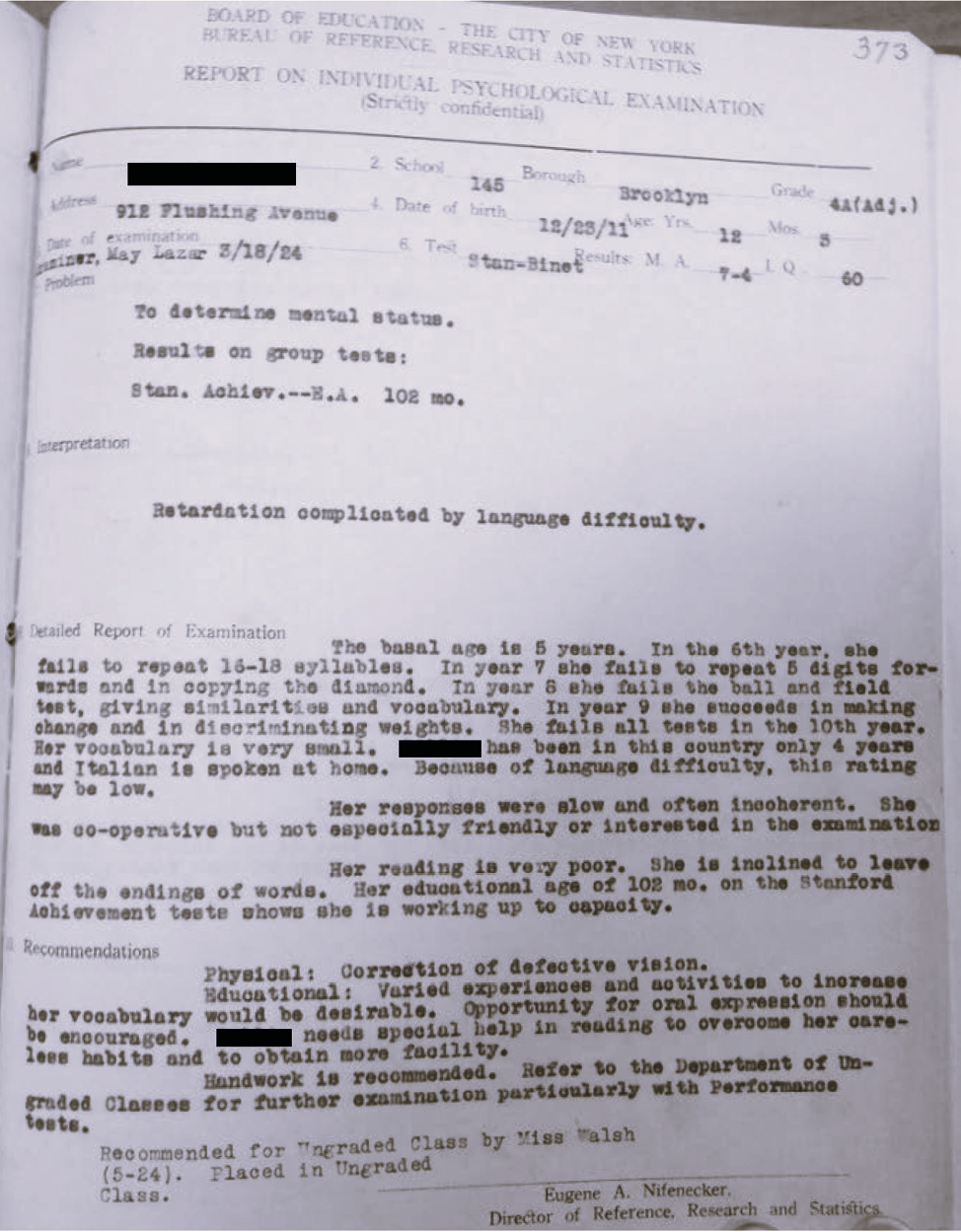
In a file compiled for P.S. 28 in Manhattan, the school’s principal Anna Short «requested the examination with individual psychological tests of 50 pupils with I.Q.’s of 70 or below on the National Intelligence Test», with the purpose to «determine more accurately the intellectual status of those pupils with the idea of forming another ungraded class or some other type of special class» (Bureau of Reference 1924a, 1). Of the 50 examined pupils, 20 were labeled as «foreign born», with 10 pupils coming from Italian families. In other reports, the tested pupils are not as clearly labeled as stemming from Italian families, yet we can deduce their background from the brief reports recorded for each individually examined pupil since these often offer «language difficulties» as an explanation for poor performance in schools. These assertions are sometimes accompanied by statements such as «Child gave several responses correctly in Italian» or failure to respond to test questions «due to language difficulties» (Bureau of Reference 1924b, 2). In the case of the Reclassification Project conducted in P.S. 145 in Brooklyn in 1924 on behalf of Principal Hazen Chatfield, the shorter individual evaluations were complemented by psychological examinations, which allotted more space to the individual pupils’ test results (Bureau of Reference 1924b). These individual reports were divided into sections recording the problem, an interpretation of the results, a detailed report of the examiner and their recommendations (see figure 1). At the very bottom of the form, the final decision with regard to reclassification was recorded. In most cases, the examined pupils were either recommended to stay in the special adjustment class or – depending on availability – were to be transferred to an ungraded class.
3. Pupils from italian families in Chicago
Although compared to New York City Chicago had a lower number of inhabitants born in Italy or with an Italian background, the city nonetheless represents another influential hub of Italian immigration. Between the 1880s and 1920s, the number of immigrants arriving from Italy rose to 59,215 in 1920 (United States Bureau of the Census 1922, 247). While the first wave of Italian immigrants up to the 1850s originated mostly from Northern Italy, starting in the 1880s, the vast majority of later arrivals came from Southern Italy (Nelli 1979). Mostly working as laborers, Italians moving to Chicago represented a highly mobile group when it came to settling patterns, and they did not form specifically rigid neighborhoods or “colonies”, but were rather dispersed throughout the city (Nelli 1979, 47, 53).
Due to the «pressure of numbers», Chicago had to pass quickly from a school organization geared towards a village to a city system adopting governance forms from the East Coast (Tyack 1974, 27–28). The city’s school system was greatly influenced by the Graded Course of Instruction famously introduced by William H. Wells (1812–1885) in 1862 (Herrick 1971, 42–43), who served as the city’s superintendent from 1856 to 1864. This curriculum emphasized the connections between the gradation of pupils and the corresponding study program, thus representing a landmark development on the path to the age-graded classroom (Button and Provenzo 1989, 129–130; Tyack 1974, 45–46). Just like other urban public school systems, Chicago witnessed a centralization of its administrative structures in the first decade of the 20th century, which entailed an influential Superintendent and a slimmed down Board of Education (Tyack 1974, 169). For newcomers arriving from other countries, the Chicago public schools served as a means of assimilation that did not usually exercise sensitivity with regard to the pupils’ backgrounds (Weiss, 1982, 66). Just like in New York City, the public schools faced similar problems of overcrowding and issues of “retardation” linked to performance issues (Herrick 1971; Ryan 2011).
Although Chicago’s school administration can be considered to have been more cautious and reserved when it came to their support of testing (Ryan 2011, 353), a similar research unit to the Bureau of Reference, Research and Statistics was founded in Chicago in 1899 under the name Department of Child Study and Pedagogic Investigation.9 Directed by Fred W. Smedley, the department set out to make anthropometric observations of public school pupils, which incorporated qualities such as height, weight, strength, vital capacity, and hearing. The measurements and figures were recorded in specifically prepared blank forms that prefigured which kind of information could be gathered and entered (see figure 2).
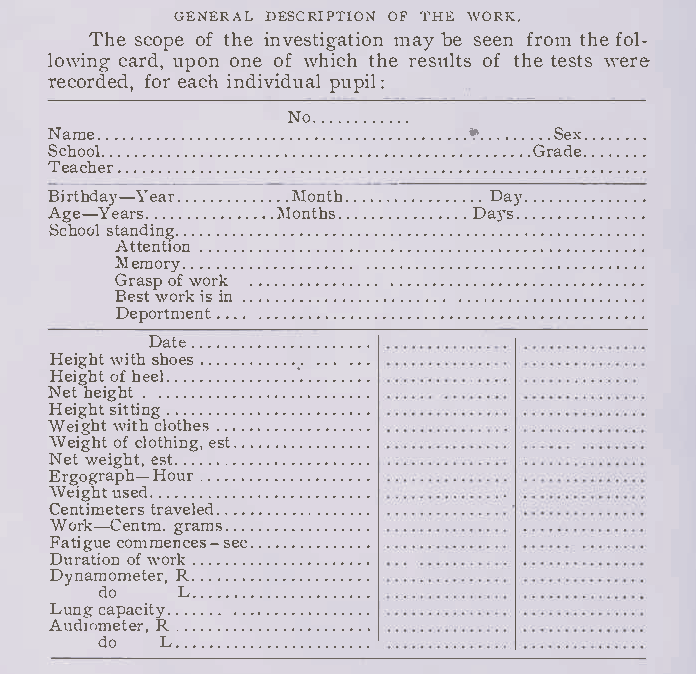
The individual observation and testing categories were then further differentiated into, e.g., «height with shoes», «height of heel», «net height» derived from the former two categories, and «height sitting» (Department of Child-Study and Pedagogic Investigation 1900, 2). The authors of the study interpreted their findings as showing that «on the average those pupils who have made great intellectual advancement are on the whole taller, heavier, stronger, possessed of greater endurance, and larger breathing capacity than those who have made less advancement» (Department of Child-Study and Pedagogic Investigation 1900, 25). Thus, the study conducted by Smedley and his co-author makes a distinct connection between physical factors and performance in schools – a link that they also translated to classroom organization questions, e.g., when it came to grading the pupils. At the same time, the observations made with regard to these parameters can also be used to determine «the fitness of the child to enter the first grade, where so many children under the legal school age, are entered by misguided parents to the great detriment of the children» (Department of Child-Study and Pedagogic Investigation 1900, 25). To conclude their report, the authors presented the following findings:
1. In general there is a distinct relationship in children between physical condition and intellectual capacity, the latter varying directly as the former. 2. The endurance (ergograph work) of boys is greater than that of girls at all ages, and the difference seems to increase after the age of nine. 3. There are certain anthropometric indications, which warrant a careful and thorough investigation into the subject of co-education in the upper grammar grades. 4. Physical condition should be made a factor in the grading of children for school work, and especially at the entrance into the first grade. 5. The great extremes in physical condition of pupils in the upper grammar grades, make it desirable to introduce great elasticity into the work of these grades. 6. The classes in Physical Culture should be graded on a physical instead of an intellectual basis (Department of Child-Study and Pedagogic Investigation 1900, 45).
The report hence establishes a connection between pupils’ physical conditions and their intellectual performance in school, which in turn should be acknowledged and considered in school organization decisions and specifically in procedures of allotment to school grades. The statements connecting a healthy body with a high academic performance already border on concepts of eugenics as is, but this is even intensified by the remarks made about the “influence of nationality” on intellectual capacity displayed in school: «In certain of the Chicago schools the great bulk of the population is Italian, in others Bohemian, in others Scandinavian, in others Russian, and so on. These children bring into their school work characteristic hereditary tendencies of the great nations from which they are descended», which Smedley suggests to further investigate through systematic study to get to know the «national peculiarities of these children» (Department of Child-Study and Pedagogic Investigation 1900, 46–47).
Although the authors refrain from making further assumptions about the pupils from Italian families specifically and how they perform in their respective elementary school grades, Smedley et al. still raise the «national peculiarities» as an influential additional category, which establishes a link between nationality and school performance. They use Italian pupils as an example of a failing group in the grand scheme of different nationalities’ educational success. As to school performance, according to the report, “backward” pupils assigned to ungraded classes «present a problem». For this category of pupils, the report suggests having them examined individually by a trained psychologist (Department of Child-Study and Pedagogic Investigation 1900, 47). They should then be placed in specific grades or classes, if feasible.
4. Classifying difference to regulate and align «failing» pupils
Although the sources and educational settings from both case studies might vary with respect to their particular focus, they nonetheless show how studies and surveys either commissioned (New York City) or approved (Chicago) by city school administrations produced the label of the “failing immigrant pupil” by classifying pupils from different ethnicities according to their academic success. With pre-defined categorizations and backed by “scientific” means of analysis, the Reclassification Projects, Reports of the Department of Child Study, or other surveys conducted by specific educational research units show how educators and school administrations translated and operationalized psychological and psychometric knowledge. Grounded in publications issued by experts in (education) statistics, developmental psychology (Ayres 1909; Goddard 1914) as well as intelligence testing (Binet and Simon 1916; Terman 1916), school officials developed testing instruments to identify certain groups of children they considered “problematic”, “backward” or “retarded”. The forms and blanks represented the vehicles utilized by the examiners and test personnel to translate and operationalize the established psychometric and psychological knowledge, turning them into handy and reproducible means of testing and recording. In many cases, the pupils’ “failing” status, which was determined through their test scores and examination results, intersected with their ethnic and social class background. Pupils of Italian descent, and from Southern and Eastern European origins more generally, were classified as failing, while other groups, such as pupils from German families, even outperformed their American peers (Ayres 1909, 107). This is exemplified in large scale surveys, such as Ayres’s Laggards in Our Schools (1909), investigating the “underperformance” of schoolchildren and how low achievement was particularly prevalent in certain ethnic groups and nationalities. Here, children from families that had immigrated from Southern or Eastern Europe, and especially from Italy, were considered to be among the lowest performing pupil groups (Ayres 1909, 116). Aside from their performance in school, this group was attested low morals and aspirations expressed in contemporary assessments such as the following: «Largely illiterate, docile, lacking in initiative, and almost wholly without the Anglo-Saxon conceptions of righteousness, liberty, law, order, public decency, and government, their coming has served to dilute tremendously our national stock and to weaken and corrupt our political life» (Cubberley 1919, 338).
When comparing the local implementations of identifying “underperforming” or “failing” pupils between Chicago and New York City, we find that both cities introduced testing as a measure of regulating pupil populations – even if one system was more lenient to tests and examinations than the other. Although the studies on retardation actually revealed fewer differences between “underperforming” pupils from native families and pupils from immigrant families, the discourse still highlighted the issue of retardation in connection with non-native schoolchildren – particularly with regard to the group of Italian and other Southern European immigrants. As the individual reports conducted as part of the Reclassification Projects show, command of the English language represented a key factor highlighted in the examiners’ assessments. Aside from language issues, the sources published by the Department of Child Study specifically emphasize the effect of physical performance on intellectual abilities, and although the pupils’ social and class background was not a central focus of these studies, the correspondence between the living conditions of immigrant families could have been a deciding factor contributing to physical impairments and an overall poor physical condition. This is hinted at in the individual psychological examination reports filed in selected Reclassification Projects since they allude to certain physical conditions exhibited by the examined pupils. However, curiously enough, they do not establish a direct connection between physical impairments such as «defective vision and hearing», «speech defect», or «nasal breathing» (Bureau of Reference 1924b) and their potential effects on school performance and educational attainment.
The solution for dealing with pupils who had been attested “retardation” was to either them to special or ungraded classes, hence removing them from the regular graded school system. By looking at how different municipal education systems conceptualized and responded to children perceived as deviating from established social and educational norms – and how this intersected with their ethnic background and the respective stereotypes attached to particular nationalities – this contribution focused on practices that not only reflected contemporary anxieties about cultural difference and assimilation but also actively contributed to constructing racial and cultural hierarchies within urban educational landscapes. These found their expression, for instance, in the “nationality factor”, the native-foreign parentage divide, and retardation rates ranked by nationalities (Ayres 1909, 103–108). Hence, the article sought to reveal that measures implemented in schools, such as various forms of testing and reclassification decisions, were not merely administrative procedures but powerful technologies of scientific management (see, e.g., Rice 1913). Through precise documentation and measurement, the two presented urban school administrations created intricate systems that aimed to improve the school performance of “failing immigrant” children, but that in many instances ultimately contributed to reinforcing existing social stratifications.
Bibliography
Averill, William A. 1918. “The Ages of Pupils and their Progress Through the Elementary Grades.” University of the State of New York Bulletin 665. Albany, NY.
Ayres, Leonard P. 1909. Laggards in Our Schools. A Study of Retardation and Elimination in City School Systems. New York: The Russell Sage Foundation.
Baily, Samuel L. 1983. “The Adjustment of Italian Immigrants in Buenos Aires and New York, 1870–1914.” The American Historical Review 88 (2): 281–305. https://doi.org/10.1086/ahr/88.2.281.
Binet, Alfred and Théodore Simon. 1916. The Development of Intelligence in Children (The Binet-Simon Scale) (E. S. Kite, Trans.). Baltimore: Williams & Wilkins Company.
Brinkley, Alan. 2000. The Unfinished Nation. A Concise History of the American People. Boston: McGraw-Hill.
Bureau of Reference, Research and Statistics. 1922. Pupils’ Progress Through the Grades. New York, NY.
Bureau of Reference, Research and Statistics. 1924a. Reclassification Project, P.S. 28, Manhattan. Series 711. Box 3. RR-351. NYC Department of Records / Municipal Archives.
Bureau of Reference, Research and Statistics. 1924b. Reclassification Project, P.S. 145, Brooklyn. Series 711. Box 3. RR-373. NYC Department of Records / Municipal Archives.
Button, H. Warren, and Provenzo Jr., Eugene F. 1983. History of Education and Culture in America. Englewood Cliffs, NJ: Prentice-Hall.
Cordasco, Francesco, and Eugene Bucchioni. 1974. The Italians: Social Backgrounds of an American Group. Clifton, N.J.: A.M. Kelley.
Covello, Leonard. 1967. The Social Background of the Italo-American School Child: A Study of the Southern Italian Family Mores and Their Effect on the School Situation in Italy and America. Leiden: Brill.
Cubberley, Ellwood P. 1919. Public Education in the United States. A Study and Reinterpretation of American Educational History. Boston, New York, Chicago: Houghton Mifflin Company.
Department of Child-Study and Pedagogic Investigation. 1900. Report of the Department of Child-Study and Pedagogic Investigation. Chicago: John F. Higgins Print.
Fass, Paula S. 2006. “Immigration and Education in the United States.” In A Companion to American Immigration, edited by Reed Ueda, 492-512. Oxford: Blackwell Publishing.
Foerster, Robert F. 1919. The Italian Emigration of Our Times (Vol. 20). Cambridge, MA: Harvard University Press.
Galenson, David W. 1998. “Ethnic Differences in Neighborhood Effects on the School Attendance of Boys in Early Chicago.” History of Education Quarterly 38 (1): 17–35.
Goddard, Henry Herbert. 1912. The Kallikak Family: A Study in the Heredity of Feeble-Mindedness. New York: Macmillan.
Goddard, Henry Herbert. 1914. Feeble-Mindedness: Its Causes and Consequences. New York: Macmillan.
Gulick, Luther Halsey, and Ayres, Leonard P. 1908. Medical Inspection of Schools. New York: The Russell Sage Foundation.
Herrick, Mary J. 1971. The Chicago Schools. A Social and Political History. Beverly Hills: Sage.
Isensee, Fanny. 2021. “‘Intelligence Tests were given in order to obtain a basis for classifying the pupils’ – Die Reclassification Projects in New York City in den 1920er Jahren.” In Schülerauslese, schulische Beurteilung und Schülertests 1880-1980, edited by Sabine Reh, Patrick Bühler, Michèle Hofmann, and Vera Moser, 225–240. Bad Heilbrunn: Julius Klinkhardt.
Isensee, Fanny. 2022. “’Recommended for Ungraded Class’ – The Construction of Normalcy in Expert Reports in 1920s New York City.” In Das A(b)normale in der Pädagogik. Wissenspraktiken – Wissensordnungen – Wissensregime, edited by Vera Moser and Jona Garz, 171–182. Bad Heilbrunn: Julius Klinkhardt.
Isensee, Fanny. 2025. The Graded School: Reassembling Public School Organization in New York City, 1805-1921. Cham: Palgrave Macmillan.
Lassonde, Stephen A. 1998. “Should I Go, or Should I Stay?: Adolescence, School Attainment, and Parent-Child Relations in Italian Immigrant Families of New Haven, 1900-1940.” History of Education Quarterly 38 (1): 37–60.
Nelli, Humbert S. 1979. Italians in Chicago: A Study in Ethnic Mobility. New York: Oxford University Press.
New York City Board of Education. 1904. Sixth Annual Report of the City Superintendent of Schools. New York, NY.
New York City Board of Education. 1914. Semi-Annual Report of the Division of Reference and Research. New York, NY.
New York (N.Y.). 1897. The Greater New York Charter as Enacted in 1897: With Notes Indicating the Derivatory Statutes and References to Judicial Decisions Relating thereto, Together with Appendixes … And the English Colonial Charters. Albany: Weed-Parsons Printing Company.
New York (N.Y.). 1901. The Greater New York Charter of 1901: Together with Constitutional Provisions Affecting the City; Provisions of the Charter of 1897, Continued until Changed by the Board of Aldermen; the Tenement House Law; the Building Code; and the Colonial Charters. New York: The Lawyers’ Co-operative Publishing Company.
Olneck, Michael R. and Marvin Lazerson. 1974. “The School Achievement of Immigrant Children: 1900-1930.” History of Education Quarterly 14 (4): 453–482.
Perlmann, Joel. 1988. Ethnic Differences. Schooling and Social Structure among the Irish, Italians, Jews, and Blacks in an American City, 1880-1935. Cambridge, MA: Cambridge University Press.
Ravitch, Diane. 2000. The Great School Wars. A History of the New York City Public Schools. Baltimore: The Johns Hopkins University Press.
Rice, Joseph Mayer. 1913. Scientific Management in Education. New York: Publishers Printing Company.
Rosenwaike, Ira. 1972. Population History of New York City. Syracuse: Syracuse University Press.
Russell Sage Foundation. 1923. Backward Children. A Selected Bibliography. New York: Russell Sage Foundation Library
Ryan, Ann Marie. 2011. “From Child Study to Efficiency: District Administrators and the Use of Testing in the Chicago Public Schools, 1899 to 1928.” Paedagogica Historica 47 (3): 341–354.
Sander, Sarah. 2016. “Raumteiler, Treppen, Pulte. Möbel und Mittler der Immigrationsadministration auf Ellis Island, New York.” In Medien der Bürokratie, edited by Joseph Vogl, Friedrich Balke, and Bernhard Siegert, 65-76. München: Wilhelm Fink Verlag.
Smedley, Fred W. 1902. Child Study in Chicago: A Report. Chicago, IL.
Terman, Lewis M. 1916. The Measurement of Intelligence. Boston: Houghton Mifflin.
Terman, Lewis M., Grace Lyman, George Ordahl, Louise Ellison Ordahl, Neva Galbreath, and Wilford Talbert. 1917. The Stanford Revision and Extension of the Binet-Simon Scale for Measuring Intelligence. Baltimore: Warwick & York, Inc.
Thompson, Frank V. 1920. Schooling of the Immigrant. New York: Harper & Brothers Publishers.
Tyack, David B. 1974. The One Best System. A History of American Urban Education. Boston: Harvard University Press.
United States Bureau of the Census. 1913. Thirteenth Census of the United States Taken in the Year 1910. Volume III Population 1910, Nebraska-Wyoming, Alaska, Hawaii, and Porto Rico. Washington, DC: Government Printing Office.
United States Bureau of the Census. 1922. Fourteenth Census of the United States Taken in the Year 1920. Volume III Population 1920. Composition and Characteristic of the Population by States. Washington, DC: Government Printing Office.
United States Bureau of the Census. 1965. The Statistical History of the United States from Colonial Times to the Present. Stamford: Fairfield Publishers.
Weiss, Bernard J. 1982. American Education and the European Immigrant: 1840-1940. Chicago: University of Illinois Press.
1 This contribution was inspired by materials and sources collected in the research project The Bureaucratization of Groupings. Local and Transnational Dynamics of Innovation in the Introduction of Age-Graded School Classes in Compulsory Education (Prussia, the USA, and Spain, ca. 1830-1930) led by Marcelo Caruso and funded by the Deutsche Forschungsgemeinschaft (German Research Foundation).
2 Throughout the text, I subsume both foreign-born and pupils born in the USA to immigrant parents as ‘immigrant pupils’ as the differences are not always clearly demarcated in the historical sources.
3 For more information on pupils from Italian (immigrant) families in the USA see, e.g., Cordasco and Bucchioni (1974; particularly chapter V), Covello (1967), and Perlmann (1988).
4 For additional studies exploring the situation of children from Italian (immigrant) families, see e.g., Fass (2006) for various US-American cities and regions, Lassonde (1988) for New Haven, and Galenson (1998) for Chicago.
5 See Isensee (2025) for a more detailed account of the Board of Education’s (and with it the Bureau of Reference, Research and Statistics’s) role in questions concerning classroom and school organization measures.
6 For a detailed discussion of retardation and its impact on school and classroom organization, see Isensee (2025).
7 Initiated in 1907 and funded by the Russell Sage Foundation, this study set out to investigate «so-called retardation among school children» (Gulick and Ayres 1908, ix). In the first decades of the 20th century, the topic of “backward children” struck a particular chord throughout the country, and studies examining this concept were conducted across the United States – see Russell Sage Foundation (1923).
8 For a more in-depth account of the role of Reclassification Projects in constructing normalcy, see Isensee (2022); for a conceptualization of Reclassification Projects as a specific administrative sorting mechanism, see Isensee (2021).
9 For a brief introduction to the founding of the Department of Child Study and Pedagogic Investigation and its function and tasks, see Smedley (1902).